
Incorporating an Alberta company is only the beginning of its legal life.
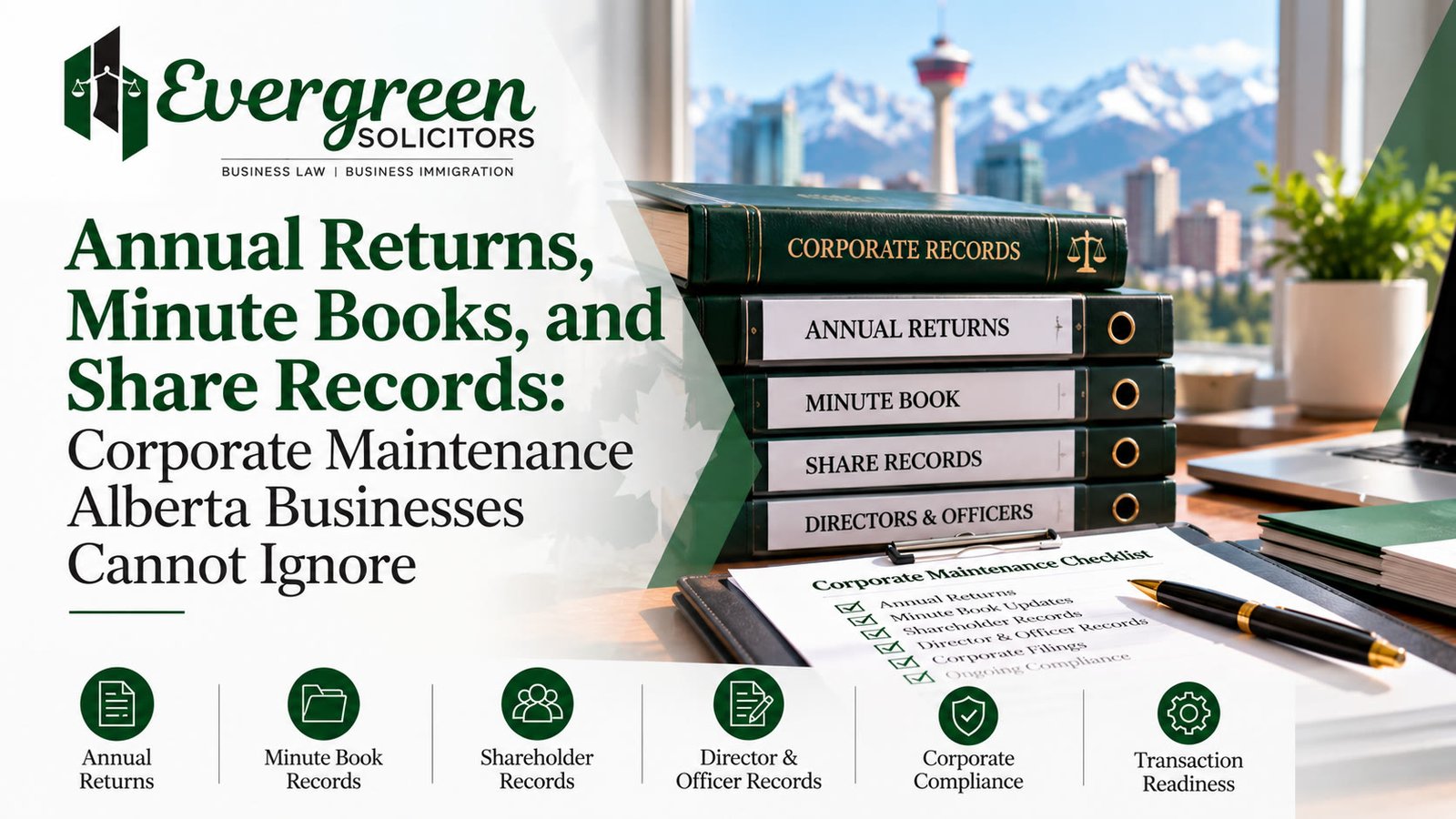
Once a corporation has been established, its directors and shareholders need to ensure that required filings are made, corporate records remain accurate, and important decisions and ownership changes are properly documented.
For many privately held Alberta corporations, however, corporate maintenance receives little attention until something important happens.
A bank requests records before financing.
A new investor wants to review the company.
A shareholder dispute develops.
The owners decide to sell.
Or someone discovers that annual returns have not been filed.
At that point, years of missing corporate records can turn a routine transaction into a corporate cleanup project.
Regular corporate maintenance can help avoid this problem.
What Is Corporate Maintenance?
Corporate maintenance refers to the ongoing legal and administrative work required to keep a corporation’s information, filings, governance records, and ownership documentation current.
For an Alberta corporation, this can involve several areas:
- annual Corporate Registry filings;
- corporate minute-book maintenance;
- director and officer records;
- shareholder records;
- securities registers;
- documentation of share issuances and transfers;
- shareholder and director resolutions;
- amendments to corporate information; and
- documentation of significant corporate transactions.
Not every corporation will have the same requirements or activity, but every corporation should have a system for keeping its legal records current.
Annual Returns Are Not Optional
An Alberta corporation must file an annual return.
The annual return helps keep prescribed information about the corporation current with Alberta Corporate Registry.
Importantly, an annual return is not the same thing as the corporation’s income-tax return.
These are separate obligations.
The Government of Alberta warns that if a corporation does not file its annual return, the corporation may ultimately be dissolved.
For an active business, involuntary dissolution can create serious problems.
Business owners should therefore ensure that annual corporate filings are tracked rather than assuming their accountant, registry provider, or lawyer is automatically handling them.
What Is a Corporate Minute Book?
A corporate minute book is the organized collection of a corporation’s important governance and ownership records.
Depending upon the corporation and its history, the records may include:
- Articles of Incorporation;
- amendments to the articles;
- corporate bylaws;
- organizational resolutions;
- registers of directors and officers;
- shareholder information;
- securities registers;
- share certificates or related records;
- shareholder resolutions;
- director resolutions;
- shareholders’ agreements;
- records of share issuances and transfers; and
- documentation concerning significant corporate changes.
The minute book effectively tells the legal story of the corporation.
Why Does the Minute Book Matter?
When a corporation has one shareholder and conducts routine business, keeping formal records may not seem urgent.
The importance becomes much clearer when a significant transaction occurs.
Business Financing
A bank or private lender may conduct corporate due diligence before advancing funds.
If corporate records are incomplete, financing can be delayed while documents are reconstructed or corrected.
Sale of the Business
A prospective buyer will typically want to confirm that the seller owns what it claims to own and that the corporation has been properly organized and maintained.
Incomplete share records or undocumented transactions can become due-diligence issues.
New Investors
An investor will want to understand the corporation’s ownership and authorized share structure.
Shareholder Disputes
When shareholders disagree, incomplete documentation can make it considerably more difficult to establish what was approved and who owns what.
Corporate Reorganization
Lawyers and accountants need reliable corporate information before implementing many reorganizations.
Good corporate records therefore become particularly valuable precisely when the business is undertaking an important transaction.
Keep Share Records Accurate
A corporation should be able to determine clearly who its shareholders are and what shares they own.
Share ownership should not be based solely on an informal spreadsheet, verbal understanding, or accounting records.
Corporate records should properly document matters such as:
- share subscriptions;
- share issuances;
- classes of shares;
- number of shares;
- transfers;
- redemptions or repurchases; and
- changes resulting from reorganizations.
When ownership records are inconsistent, a future financing, sale, estate matter, or shareholder dispute can become much more complicated.
Document Director and Shareholder Decisions
Corporations make decisions through the mechanisms established by corporate law and their governing documents.
Depending upon the matter, appropriate director or shareholder approval may be required.
Examples of transactions that may require corporate documentation include:
- issuing shares;
- appointing officers;
- changing signing authorities;
- approving major agreements;
- declaring dividends;
- borrowing money;
- granting security;
- purchasing significant assets;
- selling significant assets;
- entering major transactions; and
- reorganizing the corporation.
The exact approvals required depend on the circumstances.
The key is to document important corporate actions when they occur rather than attempting to reconstruct approvals years later.
Update Corporate Changes Promptly
Corporations evolve.
Directors change.
Businesses relocate.
Shareholders transfer shares.
New investors join.
Companies reorganize.
Certain changes require filings with Alberta Corporate Registry, while others need to be reflected in the corporation’s internal records—or both.
Alberta provides formal processes for changes involving matters such as corporate addresses, directors, agents for service, amendments, reorganizations and other corporate information.
Corporate records and public filings should therefore be reviewed whenever significant changes occur.
The Problem With “We’ll Fix the Minute Book Later”
Corporate cleanup is possible in many circumstances, but postponing maintenance can create unnecessary difficulty.
Imagine a Calgary corporation that has operated for ten years.
During that period:
- two shareholders left;
- another shareholder joined;
- shares changed hands;
- directors changed;
- the company obtained financing;
- dividends were paid;
- the business moved twice; and
- several major agreements were signed.
If little of that activity was properly reflected in the corporate records, reconstructing the history can require reviewing accounting files, agreements, bank documents, correspondence, tax records, and the recollections of the people involved.
That is very different from updating the records annually.
Corporate Maintenance Before Selling a Business
Owners planning to sell should review their corporate records well before the company goes to market.
Potential issues to identify include:
- missing annual returns;
- outdated director information;
- incomplete minute books;
- undocumented share transfers;
- discrepancies in share ownership;
- missing resolutions;
- outdated shareholder agreements;
- unresolved corporate changes; and
- incomplete documentation for previous transactions.
Resolving these issues early can make the eventual due-diligence process more efficient.
Corporate Maintenance Before Financing
The same principle applies when seeking business financing.
Before approaching a lender, an Alberta corporation may benefit from confirming that:
- it remains active and in good standing;
- corporate filings are current;
- borrowing authority can be properly approved;
- directors and officers are correctly recorded;
- ownership information is accurate; and
- corporate records support the proposed financing transaction.
For secured lending, additional legal documentation and registrations may also be required.
Consider an Annual Corporate Legal Review
For many privately held companies, an annual corporate review can be an efficient way to prevent records from falling behind.
The review might consider:
- whether the annual return has been filed;
- whether directors and officers have changed;
- whether addresses or agent-for-service information changed;
- whether shares were issued or transferred;
- whether major corporate decisions require documentation;
- whether the minute book is current;
- whether shareholder arrangements still reflect the owners’ intentions; and
- whether upcoming financing, restructuring, succession, or sale plans require additional preparation.
Corporate maintenance is usually easier when handled regularly rather than immediately before a deadline or transaction.
Is Your Alberta Corporation Up to Date?
A corporation’s legal records should accurately reflect the business that exists today.
Evergreen Solicitors assists Calgary and Alberta corporations with annual corporate maintenance, minute books, corporate records, share transactions, shareholder agreements, reorganizations, financing, acquisitions, and business sales.
If your company has fallen behind, corporate records can also be reviewed to identify gaps and determine what corrective work may be appropriate.
This article provides general information only and does not constitute legal advice. Corporate obligations and required approvals depend on the circumstances of the corporation and the transaction involved.