
Canadian beneficial-ownership transparency rules increasingly require corporations to identify the individuals who ultimately own or control them. The applicable obligations depend on where a corporation is incorporated and, in some circumstances, where it carries on business.
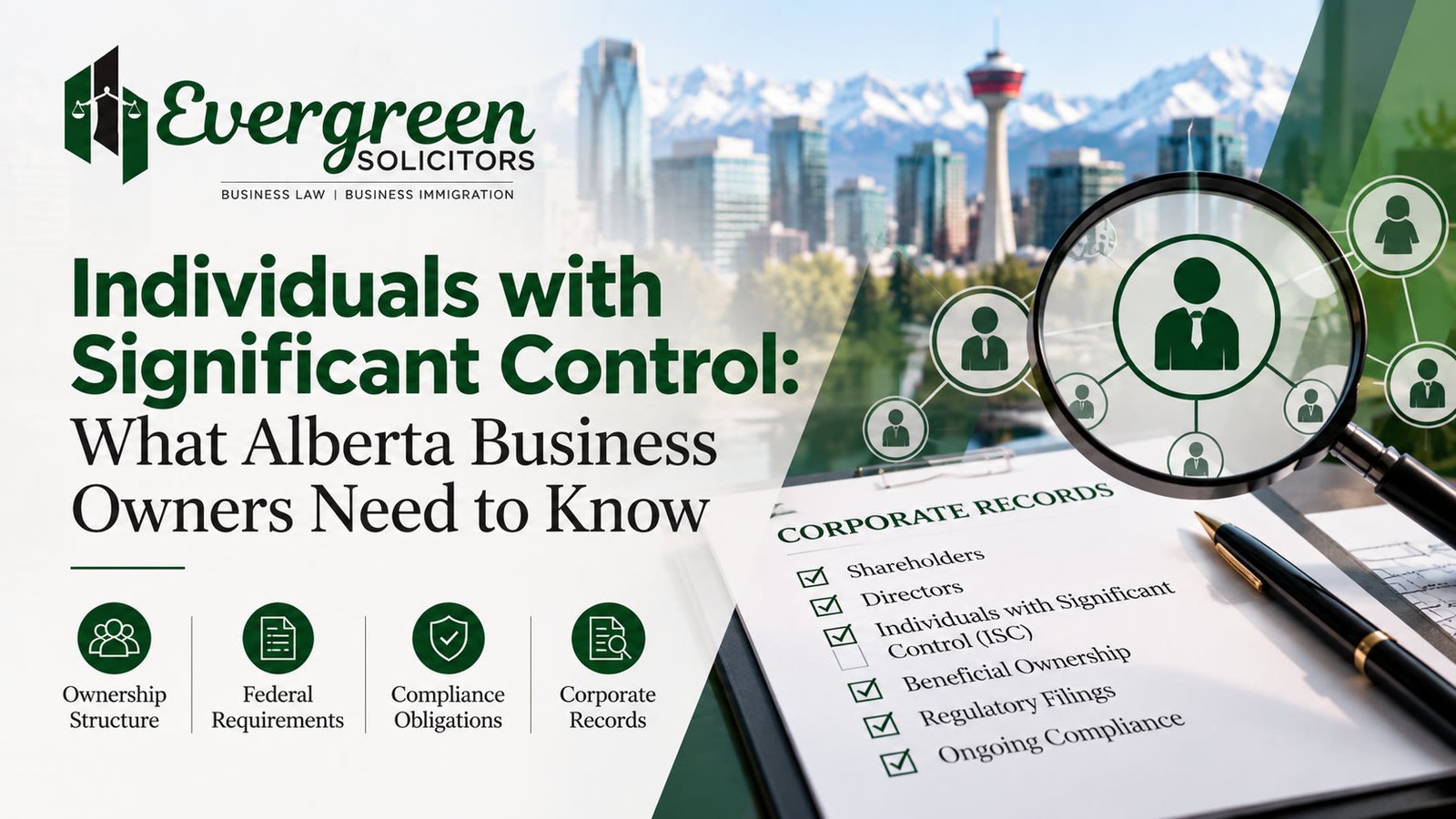
For Alberta business owners, the message is straightforward: an Alberta head office does not necessarily mean Alberta corporate-law requirements are the only rules in play.
What is an Individual with Significant Control in Canada?
Under the federal Canada Business Corporations Act (the CBCA), an individual with significant control, or ISC, generally includes an individual who holds, beneficially owns, or controls 25% or more of a corporation’s voting rights or shares measured by fair market value.
The definition also captures an individual with direct or indirect influence that, if exercised, would result in control in fact of the corporation—even if that person does not hold shares directly.
The analysis can extend beyond a corporation’s share register. Individuals may be ISCs through joint ownership, voting arrangements, trusts, holding companies, nominee arrangements, or other layered ownership structures. The inquiry looks to the natural person or persons who ultimately own or control the corporation.
Federal corporations: recordkeeping and public disclosure
Private corporations governed by the CBCA must maintain accurate ISC information. They must file prescribed ISC information upon incorporation and with their annual return, and they must report prescribed changes within the applicable filing period.
Some of the filed information is published by Corporations Canada, including an ISC’s name, address for service (or residential address if no address for service is provided), the dates on which control began or ended, and a description of how control is exercised. Certain information, including dates of birth and tax-residence information, is not displayed publicly.
In limited circumstances, an ISC or corporation may seek to prevent public disclosure—for example, where publication could create a serious threat to an individual’s safety. Individuals under 18 are not publicly listed.
The CBCA also contains significant consequences for non-compliance. A director or officer who knowingly authorizes, permits, or acquiesces in certain contraventions may face substantial fines, imprisonment, or both. The specific consequence depends on the nature of the contravention.
Where does Alberta stand?
Alberta has not yet implemented an ISC-register requirement under its Business Corporations Act. However, beneficial-ownership transparency requirements are evolving across Canada, and Alberta businesses should monitor developments closely.
The absence of an Alberta ISC register does not remove every potential obligation. An Alberta company incorporated or continued under the CBCA is subject to the federal ISC regime, regardless of where its head office is located. Businesses operating outside Alberta may also face additional registration or transparency requirements. For example, an Alberta business carrying on an enterprise in Québec should obtain Québec-specific advice about registration and ultimate-beneficiary disclosure obligations.
Beneficial-ownership information may also be tested in banking, financing, real-estate, and other regulated transactions. Inconsistencies between corporate records and information provided to regulated entities can cause delays, follow-up questions, and potential reporting consequences.
A practical checklist for business owners
Before your next annual return, consider whether your corporation should:
- identify all direct and indirect individuals who may meet the ISC test;
- review shareholder agreements, voting arrangements, trusts, nominees, and holding-company structures;
- confirm that ISC information and supporting corporate records are accurate and current;
- consider whether an address for service is appropriate; and
- seek advice before a financing, corporate reorganization, sale, or interprovincial expansion.
Need help reviewing your corporation’s ownership records?
Evergreen Solicitors assists Alberta business owners with incorporations, shareholder agreements, corporate records, reorganizations, and beneficial-ownership compliance questions. If your corporation has multiple shareholders, a holding company, a family trust, nominee arrangements, or voting agreements, we can help you identify the information that may require review.
Speak with an Alberta Business Lawyer at Evergreen Solicitors today
Last reviewed: 2026-09-14. Corporate-transparency requirements can change. This article provides general information only and is not legal advice.