
For many entrepreneurs, incorporating is an important milestone. It transforms a business into a separate legal entity and creates a formal framework for ownership, management, financing, and future growth.
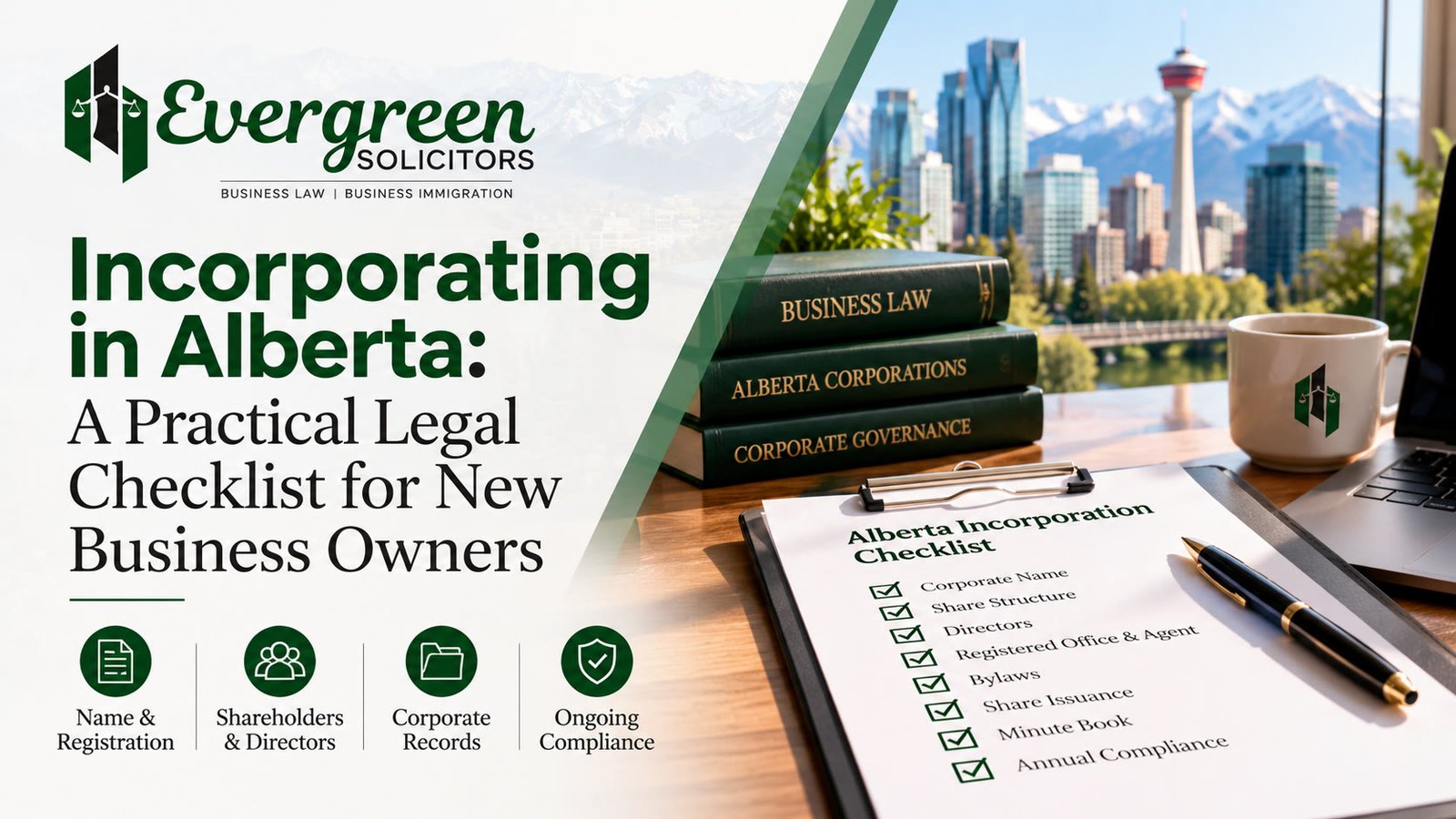
But incorporating an Alberta business involves more than registering a company name.
Decisions made during incorporation can affect shareholders, voting control, financing, tax planning, succession, and a future sale of the business. Getting the corporate structure right at the beginning can therefore prevent considerably more complicated changes later.
For entrepreneurs starting or growing a business in Calgary and elsewhere in Alberta, the following checklist highlights some of the legal issues to consider.
1. Decide Whether Incorporation Is Appropriate
Before incorporating, first consider whether a corporation is the appropriate structure.
An Alberta corporation is a legal person separate from its shareholders. That distinction can provide important advantages, but corporations also have ongoing legal, accounting, tax, and administrative obligations.
Factors to consider include:
- the nature and risk profile of the business;
- number of owners;
- anticipated revenue and growth;
- financing requirements;
- plans to introduce investors;
- potential employees;
- tax considerations;
- succession planning; and
- plans for an eventual sale.
Your lawyer and accountant can play complementary roles in this decision.
2. Determine Who the Shareholders Will Be
Who owns the company?
That question sounds simple, but it can become complicated quickly.
Where there is more than one founder, determine the intended ownership percentages before incorporation.
For example, founders should consider:
- initial ownership percentages;
- financial contributions;
- intellectual property contributions;
- future capital requirements;
- whether ownership is tied to continued involvement;
- what happens if a founder leaves early; and
- whether additional investors may eventually be introduced.
A 50/50 ownership structure may appear fair, but founders should also consider what happens when they fundamentally disagree.
Ownership and decision-making should be considered together.
3. Choose an Appropriate Corporate Name
An Alberta corporation can generally use a numbered name or an approved word name.
For a word name, Alberta’s naming requirements contemplate a distinctive element, descriptive element and legal element. Legal elements can include terms such as Ltd., Inc. and Corporation.
When using a word name, a name search is required as part of the incorporation process.
Corporate name registration should not be confused with trademark protection. Businesses developing an important brand should separately consider whether trademark advice and protection are appropriate.
4. Determine the Share Structure
The corporation’s articles establish its authorized share structure.
This is an area where simply selecting a generic structure without considering the company’s future can create problems.
Different classes of shares can have different rights involving matters such as:
- voting;
- dividends;
- redemption;
- conversion; and
- participation in the corporation’s assets post-liquidation.
The appropriate share structure depends upon the company’s ownership, tax planning, financing plans and longer-term objectives.
Where tax considerations are involved, corporate counsel may work with the company’s accountant or tax adviser when establishing the structure.
5. Identify the Directors
Directors are responsible for managing or supervising the management of the corporation’s business and affairs, subject to the corporation’s governing documents and applicable law.
Founders should therefore think carefully about who will serve as directors.
The distinction between a shareholder, director, and officer is also important.
A shareholder owns shares.
A director participates in corporate governance.
An officer holds an appointed management position within the corporation.
In a small owner-managed corporation, one person may occupy all three roles, but legally the roles are distinct.
6. Establish the Registered Office and Agent for Service
An Alberta corporation requires the prescribed corporate information, including an Alberta agent for service.
The agent for service is an individual located in Alberta who can receive notices and documents on behalf of the corporation.
Businesses should ensure this information remains current after incorporation. Changes in corporate information should be properly documented and, where required, filed with the Corporate Registry.
7. Prepare the Incorporation Documents
An Alberta incorporation typically involves documentation including:
- Articles of Incorporation;
- Notice of Address;
- Notice of Directors; and
- Notice of Agent for Service.
Depending upon the circumstances, additional documentation or searches may be required.
Once the incorporation requirements have been completed and accepted, a certificate of incorporation is issued.
But that should not be treated as the end of the process.
8. Organize the Corporation After Incorporation
After the corporation legally exists, organizational matters should be completed.
Depending upon the corporation, these may include:
- adopting corporate bylaws;
- appointing officers;
- issuing shares;
- documenting share subscriptions;
- approving banking arrangements;
- establishing the corporation’s financial year;
- approving significant initial agreements;
- documenting organizational resolutions; and
- creating the corporation’s minute book and required registers.
This step is frequently overlooked when entrepreneurs use basic registration services through a corporate registry agent.
A certificate of incorporation proves the corporation exists. It does not necessarily mean all of the corporation’s internal legal organization has been properly completed.
9. Create and Maintain a Corporate Minute Book
The corporation’s records provide an ongoing history of its legal organization and important decisions.
Depending on the corporation, records may include:
- articles and amendments;
- bylaws;
- shareholder information;
- director and officer information;
- securities registers;
- shareholder resolutions;
- director resolutions;
- shareholder agreements; and
- significant corporate documents.
Accurate records become particularly important when the business seeks financing, introduces an investor, undergoes due diligence, reorganizes, or is sold.
Trying to reconstruct several years of corporate history immediately before a major transaction can be expensive and time-consuming.
10. Consider a Shareholders’ Agreement
If the company has two or more shareholders, the founders should consider whether a shareholders’ agreement is appropriate.
A shareholders’ agreement can establish rules concerning:
- decision-making;
- management;
- financing;
- share transfers;
- admission of new shareholders;
- departures;
- death or disability;
- dispute resolution;
- deadlocks; and
- sale of the company.
The best time to negotiate these rules is often when the owners are starting the business and share a common vision.
11. Review Important Business Contracts
The corporation may also require contracts appropriate to its operations.
Depending on the business, these could include:
- service agreements;
- supplier agreements;
- confidentiality agreements;
- independent contractor agreements;
- commercial leases;
- licensing agreements;
- financing documents; and
- purchase or distribution agreements.
A properly incorporated company can still face significant risk if its commercial relationships are poorly documented.
12. Coordinate With Your Accountant
Corporate legal and tax matters frequently intersect.
Your accountant may advise on issues including tax registration, corporate tax compliance, GST/HST requirements, payroll, compensation, and tax planning.
Corporate lawyers and accountants often work together where share structures, reorganizations, acquisitions, financing, or succession planning involve both legal and tax considerations.
13. Understand Your Annual Corporate Obligations
Incorporation creates continuing responsibilities.
An Alberta corporation must file its annual return to remain active and in good standing. Failure to file can ultimately result in dissolution.
Corporate records should also be updated as changes occur rather than waiting several years and attempting to reconstruct the company’s history.
Examples include changes involving:
- shareholders;
- directors and officers;
- addresses;
- share issuances or transfers;
- financing;
- major transactions; and
- corporate reorganizations.
Build the Corporate Foundation Properly
Incorporation should be approached as the establishment of a legal framework for the business—not simply the purchase of a certificate.
The decisions made at this stage can affect the company for years.
Evergreen Solicitors assists Calgary and Alberta businesses with incorporations, corporate organization, shareholder agreements, corporate maintenance, commercial agreements, financing, reorganizations, acquisitions, and sales.
If you are starting or incorporating a business in Alberta, or you intend to incorporate federally, speak with an Alberta business lawyer at Evergreen Solicitors about establishing the appropriate corporate structure from the outset.
This article is intended as general information and does not constitute legal, tax, or accounting advice.